Saturday, October 06, 2007

What Makes Science Scientific?

This is a question that never got much play during my education. I just learned scientific facts and theories out of my textbooks, ran simple experiments, and wrote up reports on my findings. As a result, science was never very inspiring to me. What did I know about how scientists came up with these facts, tested their hypotheses, and justified the theoretical basis for this knowledge? I've always valued the scientific method, but never questioned its epistemological foundation.

Turns out this question is very interesting philosophically and essential to avoiding sloppy thinking and erroneous judgments. Especially today, what with the constant assault on reason and science from right-wing media outlets and faith-based pseudo-scientific foundations, it appears that this topic is critical to preserving and building on what scientific progress we have made. Perhaps, every high-school and college student should be required to take a philosophy of science course that teaches critical thinking skills, if only to combat the ubiquitous ideological and rhetorical attacks on science. Otherwise, we're leaving them to watch reruns of Carl Sagan's Contact on TNT in the hope that Jodie Foster's querulous questioning of faith and championing of science sparks a discussion of how important it is to have a rational framework for understanding the mysteries in our world.

It wasn't until I read a philosophy textbook on critical thinking called, How to Think About Weird Things by Theodore Schick and Lewis Vaughn that I began to think about the framework that helps us better understand our world and how it works. Scientific method relies on careful observation and the creation and testing of hypotheses. But how can we be certain that a hypothesis avoids error and represents the best understanding of the phenomenon we are trying to explain?

As Schick and Vaughn state in Chapter 7, "Science and Its Pretenders," we rely on the "criteria of adequacy":
"Because there is always more than one hypothesis to account for any set of facts and because no set of facts can conclusively confirm or confute any hypothesis, we must appeal to something besides the facts in order to decide which hypothesis is the most reasonable. What we appeal to are criteria of adequacy. These criteria help us determine how well a hypothesis accomplishes the goal of increasing our understanding." (Second ed., pg. 160)
So, what are these criteria that help hypotheses produce understanding by systematizing and unifying our knowledge? In a nutshell:
  • Testability: "A hypothesis is scientific only if it is testable, that is, only if it predicts something other than what it was introduced to explain." Note also: "To be testable, a hypothesis must make a prediction that goes beyond its background theory." (161)
  • Fruitfulness: "Other things being equal, the best hypothesis is the one that is the most fruitful, that is, makes the most novel predictions." (164)
  • Scope: "Other things being equal, the best hypothesis is the one that has the greatest scope, that is, that explains and predicts the most diverse phenomena." (167)
  • Simplicity: "Other things being equal, the best hypothesis is the simplest one, that is, the one that makes the fewest assumptions." (169)
  • Conservatism: "Other things being equal, the best hypothesis is the one that is the most conservative, that is, the one that fits best with established beliefs." (170)
Of course, Schick and Vaughn note that often, things aren't always equal and that there is no standard formula for applying any of these criteria: "Choosing between theories is not the purely logical process it is often made out to be. Like judicial decision making, it relies on factors of human judgment that resist formalization." (170) They also note, however, that this doesn't mean that examining and selecting theories is subjective: "There are many distinctions we can't quantify [for example, when day turns into night, or when a person with a full head of hair turns bald] that nevertheless are perfectly objective." (170) So, they conclude that, "In general, if someone believes a theory that clearly fails to meet the criteria of adequacy, that person is irrational." (171) Well, it appears we still have many irrational folks out there. No surprise, I guess. But I will forge ahead and try to convince the masses to vanquish their irrational demons.

So, how do we go about making a sound scientific inquiry into claims both reasonable and irrational? Schick and Vaughn suggest a four-step SEARCH formula:
  1. State the claim.
    "It's vital to state the claim in terms that are as clear and as specific as possible." (236)

  2. Examine the evidence for the claim.
    What are the reasons, either in the form of empirical evidence or logical arguments, for accepting the claim? To do this effectively, you must:
    - Determine the exact nature and limitations of the empirical evidence. (Any reasonable doubts about the data or research?)
    - Discover if any of these reasons deserve to be disqualified. (Does support for the claim break down because of wishful thinking, faith, unfounded intuition, or subjective certainty?)
    - Decide whether the hypothesis in question actually explains the evidence. "...a good hypothesis must be relevant to the evidence it's intended to explain." (236-37)

  3. Consider alternative hypotheses.
    This step involves creativity and openness of mind so that you can counteract the built-in bias toward a favorite hypothesis, consider other possibilities, and change your view in light of good reasons. (238)

  4. Rate, according to the criteria of adequacy, each hypothesis.
    - Testability: "Can the hypothesis be tested? Is there any possible way to determine whether the hypothesis is true or false?" (238)
    - Fruitfulness: "Does the hypothesis yield observable, surprising predictions that explain new phenomena?" (238)
    - Scope. "How many different phenomena can the hypothesis explain?" (239)
    - Simplicity. "Is this hypothesis the simplest explanation for the phenomenon?" (where simplest means makes the fewest assumptions) (239)
    - Conservatism. "Is the hypothesis consistent with our well-founded beliefs? That is, is it consistent with the empirical evidence--with results from trustworthy observations and scientific tests, with natural laws, or with well-established theory?" (239)
Following these steps, of course, does not guarantee that a scientific theory will get to the "truth" of a phenomenon under investigation. But this scientific method does ensure that we have a solid epistemological foundation for our exploration and understanding of the mysteries we encounter in the world based on sound critical thinking skills and reason, rather than unfounded beliefs, blind faith, or unquestioned tradition.

Saturday, July 07, 2007

Please Don't Fear the Milk

This is an old issue, but I've been hearing so much about milk from cows injected with artificial growth hormones causing premature puberty in girls that I decided to do a little research. So, I started by looking for scary email hoaxes on the urban legends page Snopes.com.

Turns out you do NOT have to fear that milk from cows treated with growth hormones will cause your prepubescent girls to go into puberty early. Although the use of recombinant bovine somatotropin (rBST) used to boost milk production in cows is controversial, the FDA finds that milk from rBST-treated cows is no different from non-treated cows. One of the main problems with the argument that rBST causes premature puberty is that the somatotropins are growth hormones, which don't cross functions with gonadotropins, the sexual development hormones that bring on puberty, especially when applied to different species.

At the Dairy Spot site, I found references to a pediatric study, which says that there are some indications that some girls are entering puberty earlier, but it does not speculate on the causes. The key paragraph from this article follows (which appears to be from the seminal Washington Post article I refer to below and is quoted in most of the related sites):

"Why girls might be maturing earlier, no one knows for sure. Theories abound: Girls are better nourished. They have more body fat these days. They are exposed to more chemicals. But the changes documented in Pediatrics study cannot be attributed, even in part, to bovine growth hormone for one important reason: The data for the study were collected in 1992 and 1993, before rBST was available for dairy herds in the United States (1994). And there’s another problem with the BST and early puberty theory: Children today drink less milk than they did a generation or two ago. According to the U.S. Department of Agriculture (USDA), milk consumption among girls ages 6 to 11 dropped by about one-third from the late 1970s to the late 1990s."

The best article I found on this topic is from the Washington Post called "Tempest in a Glass" (published on October 7, 2003) that even-handedly reports on this issue and debunks not only the early puberty myth, but also the antibiotics residue myth and the growth hormones in milk causes cancer myth.

It appears that although the scientific research concludes that we do not have a problem with the growth hormone and antibiotic regimens we use on cows, there are still some folks--folks with an interest in promoting an "organic" food agenda, including "nonprofits such as the Center for Food Safety, the Environmental Research Foundation, the Organic Consumers Association and the Vermont Public Interest Research Group, along with businesses including Horizon Organic, Ben and Jerry's and Whole Foods"--who believe that these practices are a threat to human health because they simply don't trust the scientific research of the FDA, NIH, or the WHO and smell a conspiracy between government and large food corporations. And as a result of their campaign of misinformation, many consumers don't seem to be getting the message that their milk is safe.

So, after reading the Post article, do you think that these myths might be the work of the "organic" milk industry that is using fear to boost sales? Or do we really have something to fear? I think the science concludes that we don't have a problem here. So, unless you like paying amount twice as much for "organic" milk, I think you can sleep easy at night knowing that among the many possible environmental hazards you face every day, your milk isn't one of them.

Related Sites

Monday, June 18, 2007

An Alternative Star Wars Universe

So, I was reading an essay about the Matrix and film genres in The Matrix and Philosophy, and it occurred to me just how George Lucas messed up in Episodes I-III and what he should have done to fix it. Basically, Mr. Lucas screwed up because he was trying to write both a Romance and a Tragedy at the same time, and not doing either particularly well. The Romance genre is a mythical quest story where the hero embarks on a great adventure to overcome terrible odds to save a kingdom, rescue a damsel in distress, or do some such heroic deeds. Tragedy, of course, is an entirely different kettle of fish. In a tragedy, the adventure turns sour in a twist of fate (remember character is fate, according to Aristotle) as a great, noble, and heroic person brings about his or her own demise, often through some sort of tragic flaw or other personal failing.

Now, I'm no expert on writing either a Romance or a Tragedy, but I am familiar with the train wreck that is Lucas' second trilogy (the Anakin/Darth Vader one as opposed to his first trilogy about Luke Skywalker), where he clearly tried to include elements of both genres in all three films. I was so disappointed with Lucas as he continually tried to include reasons for Anakin's turn to the Dark Side. Let's see, there's his being raised as a slave, his abandonment from his mother, the denial of his Jedi abilities by the Jedi council, his pain leading to anger leading hate Yoda nonsense, his lust for control and power that only the Emperor can satiate, his desire to overcome death, but let's not forget that critical scene where he goes to rescue his mother from the sand people and when he finds her tortured and dying, massacres them ruthlessly like animals in a powerful display of ruthless hate and unconscionable revenge.

This last bit of evil seems the most morally abhorrent and suggests that Anakin is possibly the most untrustworthy, unstable, psychotic hate-monger you could possibly imagine, a true psychopathic criminal mass murderer that should be locked up, at the very least. But this scene is couched in the middle of a Romance, a story of Anakin's quest for knowledge as a Jedi and the love of a woman. After Anakin confesses his crime to Padme/Amidala, why on earth would she ever love him? Wouldn't she fear him instead; and if she had the opportunity, turn him in, or at least, inform the Jedi council? And she a Senator too, who should know right from wrong in the area of genocide after evidently experiencing one at the hands of the trade federation. She doesn't even probe him about this major moral lapse, I guess because she just assumes that this is what any adolescent Jedi would do when seeking revenge for the murder of his mother. Well, it makes me wonder if she is really all that ethical; that is, if she can hypocritically overlook such a glaring impediment in her true love. I know. She just likes bad boys. Still, her character is so underdeveloped and stereotypically servile and feminine that we never get to see what is driving her love (other than motherly compassion, of course), nor do we get to explore Anakin's moral failings through her supposedly more adult perspective. Neither one of them seems capable of learning anything from the vicissitudes of life, not to mention developing moral character through these trials. Our hero fails in his quest before it even begins, and as a result of trying to plant the seeds of tragedy so often throughout the trilogy, Lucas has completely ruined the attempt at Romance. Not that this stops him dead in his script, however. Instead, he blissfully carries on with the same Hollywood platitudes, right through to an ill-fated secret marriage with a one-armed murderer and a hypocritical Queen, Senator, or whatever she is.

But not only is the Romance ruined, the Tragedy is also undermined from the get-go. We never see Anakin as a good and noble man who will inevitably experience a terrible reversal of fortune because of his own failings. Lucas morally undermines him almost from the beginning of the tale. I've never seen any kid who has had so many reasons to turn to evil. It's surprising only that he didn't turn to the Dark Side sooner. The problem with heaping all of these causes for evil one on top of the other over the course of three films is that you never get the sense that Anakin does have the seed of good in him or that he knows what it is to be good; that is, to make a conscious decision to do the right thing. Yes, there's the tip of the hat to the true love he feels for his mother and mother-surrogate, Amidala, as the motivation for his goodness. But does this really explain why he would rescue his estranged son at the end of episode VI? I really don't think so. It's as if Lucas just gave in to the old cliche that this is just one of those family bonds that can never be broken or explained--A simplistic blood is thicker than water explanation. So, I ask again: What attachment could Anakin/Vader possibly feel for Luke, given his natural penchant for evil and his willingness to cast aside his friends and loved ones, even his true love Padme, when he believes that they and she betrayed him? Where are the "seeds of good" that Luke feels still exist inside his dark father (Darth Vader)? Where is Anakin's role model for a loving sacrifice that the man Darth Vader will call upon when faced with a choice about saving his son or saving himself?

Well, the answer to the last few rhetorical questions, at least, is that Lucas never provides them. Something magical happened to Vader while he watched his son being tortured. (The lesson for the Emperor is never torture the son in front of the father, never turn your back on the father, and never have an Nardo Pace, the Empire's worst engineer build a bottomless shaft in your throne room. Hat tip to Something Awful website for the last one.) Perhaps, the God/Bright Side/Force finally awakened in him a spiritual connection to his son. We just don't know. We're left guessing as to why suddenly, miraculously he takes pity on his son. The audience, of course, is ecstatic that he chose the way he did, but Lucas didn't give us any reason to believe that this type of redemption could occur from his misguided, poorly conceived, morally suspect Anakin trilogy.

However, it didn't have to be this way. If Lucas had not tried to mix genres in his three films, but stuck with a more workable framework, he might have been able to save his entire franchise from the Dark Side of bad script writing. What I propose he should have done is to write his first story as a boy's adventure. (Sorry, girls, but you will just have to wait for someone to concoct a coming of age story for Leia, which is an excellent idea and really should be explored, but is definitely outside of Lucas' ability. Best to wait for better screenwriters, preferably women, to take a crack at that one. Ms. Boyens, are you available?) His second story should have been a traditional adventure Romance where Anakin comes of age, shows his true nobility, honesty, courage and faithfulness through the trials of the Clone Wars, and by doing so gets the girl in the end without all the morally indefensible actions, hypocrisy, and lies that currently define his character and their intimate relationship. Then, in the final film, you turn to the Tragedy of Anakin, an honest, noble Jedi who falls to the guile of the evil Emperor because he is, in fact, seduced by the desire for power. This seduction alone can provide adequate reason for his evil. By making Anakin unequivocally a hero in the first two movies, you make his downfall all the more tragic. This simple outline could have saved Lucas a lot of confused plotting and muddled character development.

A key moment, however, must be included, preferably early on in the first film--a moment that shows a loving sacrifice--not a sacrifice on Anakin's part, but originating out of his mother. My proposal to that misguided script writing team would have been to keep the slavery part, but to force Anakin and his mother to escape on their own without a bunch of silly pod racing bets and contrived Jedi meddling. However, the crucial part of this scene is that the only way Anakin survives a dangerous and desperate escape is through his mother's self-sacrifice. This scene should mirror Darth Vader's final sacrifice to save Luke using some such electrifying plot device, preferably involving her being electrocuted with flowing lightning bolts. She could be holding up electric fencing used to imprison them while Anakin escapes. She could be fending off robot guards who have electric shock guns or sticks wielding robot guards. Best of all, Jar-Jar, if inexplicably brought into existence at Lucas' insistence, could also be mercilessly killed in this ill-fated escape attempt. But to the point, this scene would be staged so as to evoke the scene where Luke is electrocuted by the Emperor at the end of episode VI. You could even have his mother give an inspiring death speech after the electrocution (wouldn't be Hollywood without a good death scene, would it?), where she sends him on a mission, empowering him to become a champion of freedom and peace. This scene would be the critical seed of self-sacrificing love planted in Anakin that he would bury and carry with him until it finally took root, grew, and yielded fruit in the one great climatic moment of The Return of the Jedi, when Vader finally casts off his self-serving desire for power and embraces humanity again by destroying the Emperor and saving his son.

Well, that would have been my proposal at the script development table. Maybe in an alternative Star Wars universe this story will be told. Or maybe we just need a new universe and a new story. One that Hollywood and Lucas can't turn over to the Dark Side.

Saturday, October 14, 2006

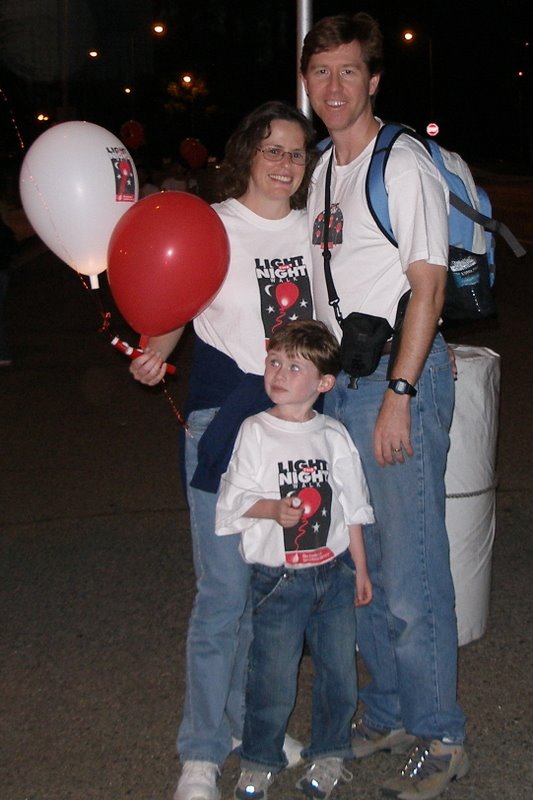
Light the Night Walk 2006

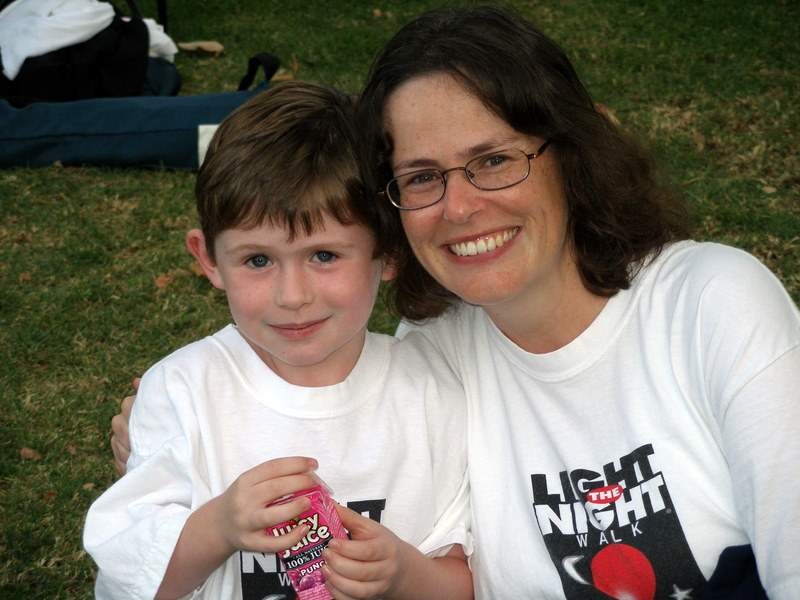
On Sunday October 8, 2006, Cindy, Ethan, and I participated in the Light the Night Walk at the Warner Center Park in Woodland Hills to help raise money for the Leukemia and Lymphoma Society. With the help of my coworkers and a $300 matching grant from Teradyne, I was able to raise $925. With the help of our family and friends, Cindy was able to raise $890. We want to thank everyone who donated money. We really are grateful to have such generous friends.

And now for the snaps. Here's Ethan and Cindy enjoying a pre-walk juice box.


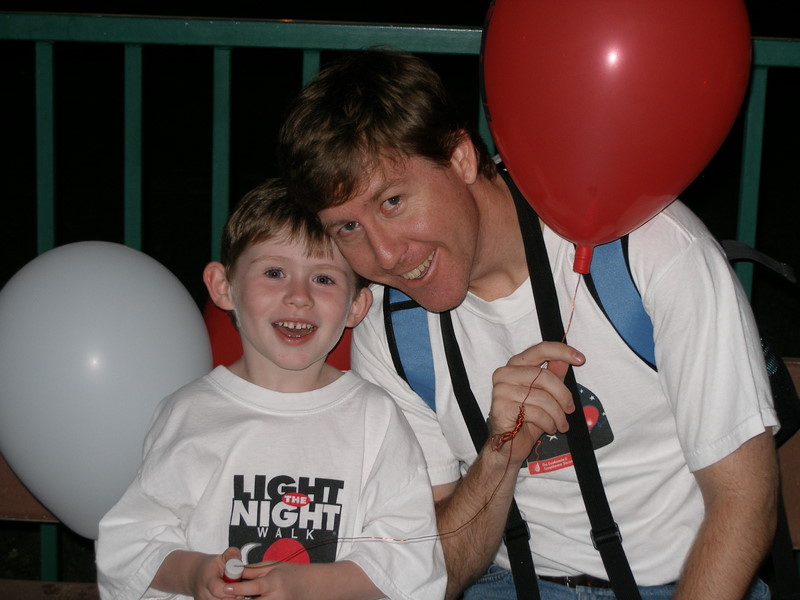
Ethan and I getting our balloons ready for lighting. To light the balloons, a simple battery powered switch runs a copper wire to a small light that stuffs into the opening of the helium filled balloon. But I must note that since IvyMike informed me about the helium shortage, I feel a little bit guilty about participating in an event that wastes so much helium. We'll have to use lighted suits in the future, I guess.


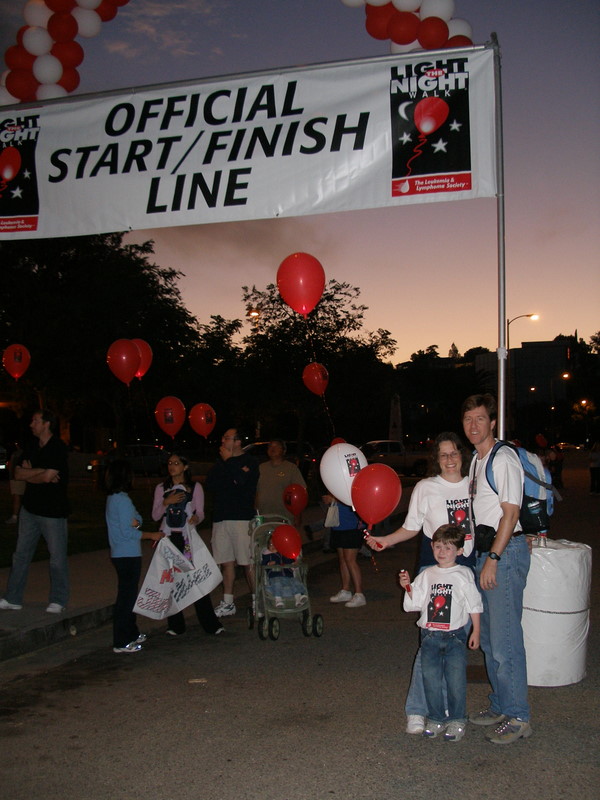
Here we are at the official start and finish line of a one and a half mile walk around the Warner Center park in Woodland Hills.


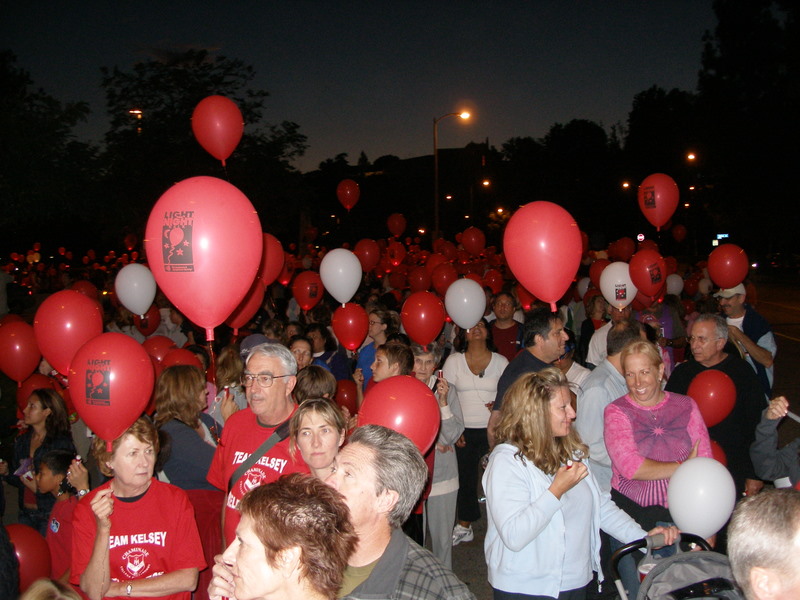
It's a good thing we got out front this year because this walk had over 2000 walkers. Here's just a few of them lining up behind the starting line. Folks were still walking near the start when we came around at the finish.


And finally, here we are at the finish. Whew!

Saturday, September 23, 2006

Things Fall Apart

Yesterday, my good friend Mike lost the left rear tire off his Nissan Titan truck at 60 mph on the 101 freeway between Westlake Blvd and Hampshire Road. Fortunately, whether by dumb luck or God's grace, no one was hurt. Mike was able to pull his truck off to the side safely, and the tire, while bouncing up quite high, didn't hit any cars and didn't cross over into oncoming traffic. My friends and I, who were heading to lunch with Mike when it happened (two of us in his truck, two in a different car), were all quite amazed at the physics of this mechanical failure and circumspect about the possibilities of a different, tragic outcome. We were all glad that this accident didn't set up some huge chain reaction of mayhem and calamity. It's disconcerting to think that you are just the plaything of randomness; that at some critical point you have no control of events whatsoever; that cause and effect will inexorably go about its necessary business, no matter what you think or do. And yet, chance still cuts you a break from time to time. Why?

It's a mystery.

So, after reflecting on this troubling mystery last night and this morning, I felt I needed a release from the inexplicable, at least for a short time. And, strangely enough, the first thing I saw this morning when I logged on was Tim Fort's kinetic art presentation, a pleasant bit of planned artistic entropy...


which reminded me of that crazy Rube Goldberg Honda ad that aired in April 2003.


Who knew that the contrivances of art and advertising could be so much fun? But all too soon, I'm afraid, I'll be back to contemplating those worrisome existential absurdities. Alas.

Friday, September 22, 2006

Tubes, Blogs, and a Scandal

YouTube is definitely the next wave on the internet. To get attention for yourself today, you've got to make a video. These word-ridden blogs are certainly destined for obscurity, if this trend continues. And to think, I just got started. Hmm...

Even Newsweek has an article this week on how the trend has moved toward "mass exhibitionism." Samuelson also notes that this exhibitionism is big business. This occured to me when I signed up with Blogger. Here's a huge community of bloggers that willingly put up Google ads with the hope that they'll collect a little extra change as their blog gets wildly popular. I haven't included Google ads on my blog...yet. How long will I be able to hold out? So far I haven't even been tempted, but then I don't really have a substantial audience. What happens if I get 10,000 hits a day? Will the temptation be too great for me to hold to my principle of not selling out to the capitalist machine? I'll save my lecture on personal integrity, selling out, and the root of all evil for later. That is, until I'm lonely, a girl, and 15 again. Hmm...

For now, let me take you back to an age of innocence--a time when only young rock and rollers with desire, voice, and sex appeal got the chance to make a video. Yes, it's the early 80's, when bands bounced about with cheap special effects and bad haircuts. The lyrics are inconsequential, but the energy is raw and real. I still love to listen to this song, even though I'm no longer a lonely, 15 year-old boy obsessed with a cute lead singer who was on MTV constantly. It takes me back, though, it really does. So, without further ado, I'll just say, "Goodbye to You."

What's in a game?

Since my last post was on a creepy game, I thought another post on some rather fun, uncreepy games was in order. IvyMike turned me on to these two gems:
  • Dicewars: Conquer contiguous territory by outrolling your opponents. IvyMike has strategy tips. [via]
  • Hyper Frame: Challenging mind puzzle is more fun than it should be. IvyMike claims he's got snaps of solutions for almost all the puzzles and will post them soon, but you won't do yourself any favors by cheating. You know how much I hate cheating. [via]
If you need more brain exercises, try Braingle.

Thursday, September 21, 2006

Gregor Awakes


Well here's a simple game to bring out your worst Kafkaesque nightmare.

Hat tip to melech.ric for pointing the way to the "game" and tapping into our deep-seated existential anxiety. Now, tell me, how often do you awake from uneasy dreams?

"AS Gregor Samsa awoke one morning from uneasy dreams he found himself transformed in his bed into a gigantic insect. He was lying on his hard, as it were armor-plated, back and when he lifted his head a little he could see his dome-like brown belly divided into stiff arched segments on top of which the bed quilt could hardly keep in position and was about to slide off completely. His numerous legs, which were pitifully thin compared to the rest of his bulk, waved helplessly before his eyes." --Franz Kafka (1883-1924), "The Metamorphosis"